Google+

Tirathgarh Waterfalls

Known as Milky Fall.

Chitrakot Waterfall

Known as Mini-Niagara Falls

Bastar Dussehra

They dont burn Ravan, its a different story

Famous Mama Bhanja Temple and Lord Ganesha Idol

Barsur have many more surprises

Chhattisgarh Tribal

Unchanged way of living and let me introduce you to a village!!

About

Faagun Mandai

Faagun Mandai
A district of Baliadela mountains, a district of Saathdhaar waterfall, a district of confluence of river Shankini and Dankini, a district of ancient city of Barsur, a district of divine pilgrim(shaktipeeth) of Goddess Danteshwari…..Yaa, I am talking about Dantewada….Dantewada is one of the important centre of Tribal unity and integrity. Right from the pre-historic period, Dantewada has led the foundation of harmony between different groups of tribes. In this way, they use to gather together for preaching the almighty goddess of power, Maa Danteshwari. This auspicious occasion, this auspicious congregation, this divine celebration is called Faagun Mandai.
Maa Danteshwari
Maa Danteshwari

Where and How to reach?
Dantewada is around 88kms far from the divisional head-quarter Jagdalpur and around 388kms away from Raipur. It is just 11km far from NH-16 towards Bailadela from Geedam. It is also approachable through rails by Vishakapatnam-Kirandul Passenger. We can reach here any time throughout the year.
For the ease of tourist, for their boarding and lodging, some good rest houses and guest houses has been made by forest department. The board of CG tourism has built a beautiful guest house on the way between Geedam and Dantewada.
dantewada map

Historical and Traditional Importance:
Madhota Tarla, renamed as Dantewada by the great dynasty of Kaktiyas, after defeating the Nagwanshi dynasty and conquering the southern part of Bastar kingdom, they led the foundation of Maa Danteshwari temple at the confluence of river Shankini and Dankini. Earlier the prayer of Goddess was being done by Royal family only, but later on the late 13th century, it got open for all the visitors and worshippers. In the same way, in the 13th century, the celebration of “Holi” incorporated and assimilated many tribal customs and tradition along the worship of Goddess Danteshwari and got a entire new format and a new name called Faagun Mandai.
Kalash pooja

Importance of Mandai:
In Bastar division, there is a unique importance of Mandai. It is a sort of cultural celebration. Normally Mandai start after Deepawali and last upto April and celebrated in different parts of this division. In some places, it is celebrated for a week, while in some places it is celebrated only for one or two days. Normally the first day is meant for the worship of respected god/diety, the next day is meant as the stale celebration of the previous day where they gather together, dance and enjoy.
Faagun Mandai and Its important days:
Sometime the customs of Tribes go parallel with the actual tradition and customs of the common hindus, sometime they go entirely different. It may be a coincidence that the ending customs of Faagun Mandai fall on the same day along with “Holika Dahan”, but rest customs are entirely different.
Faagun Shukla Shashti- KALASH STHAPNA
It’s the day for the worship of Maa Danteshwari and Mata Shailputri. From Maa Danteshwari temple, the “Chhatra” of Goddess is taken to Mendka-Dobra(a kind of plane ground used for all rituals) and is worshipped there. On this first day, the pooja of Mata Gauri and Lord Ganesh is also done. Then they perform “Kalash-sthapna” by the ingredients of lali, paddy, rice and turmeric.
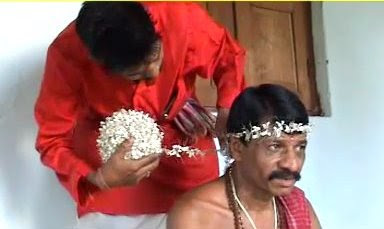
Here, Phool Pagdi rashm is also performed, where is Bandharin flower is used to make a traditional crown called “phool-pagdi”. After wearing this “pagdi”, priest goes to Lord Narayan temple nearby and bring back the palanquin of Goddess, after offering food to Goddess(mata ko bhog lagana).
TAADPHALANGGA-DHUNI

Faagun Shukla Shaptmi- TAADPHALANGGA-DHUNI
In the morning, Pooja starts from the worship of Goddess Brahmacharini mata. Like the first day, the palanquin of Goddess Danteshwari is brought to Narayan temple with the guard of honour. Then priest take “taad-phalangga”(a leaf of Palm tree) and worship at pond nearby. In all this process, there person are very important namely the head priest, the asstt. priest and bara-lankawaar(means different twelve persons including tribes) .
tribal culture

Faagun Shukla Ashtmi- KHURKHUNDNI
The day starts with the worship of Mata Chandraghanta. Its is called “khurkhundni” because it is the day when Goddess Danteshwari is informed about other deities like Hinglajin, Dhawdain, Totakamin, Gallepalin, Ganganati e.t.c. All this palanquins are then taken to Mendka-dobra, then Goddess Danteshwari is invited to Mendka-dobra by anyone tribe.
Faagun Shukla Navmi- NACH-MANDMI
The day begins with the pooja of Mata Kushmanda, wearing flower crown, priest comes to Narayan temple with all deities(palanquins).After feeding Mata, all villagers return back. Then bara-lankawaar dance and celebrate this day.
Faagun Shukla Ekadashi- LAMHA-MAAR
The day starts with the worship of Skand mata, then the palanquin of skand mata, Goddess Danteshwari, and Maa Bhuvneshwari are brought to Narayan temple and then they are given honour of salutation. After this, the palanquins are brought back.
tribal tradition
source: www.dantewada.gov.in

tribal ritual
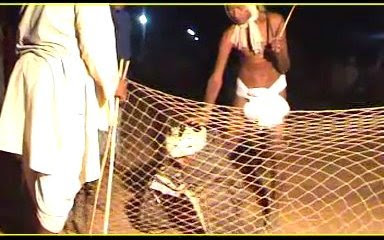
In the night, Gayta tribal man becomes a rabbit(lamha) , the katiyar tribe becomes hunter, then they perform the act of catching prey. This act is done two times, one inside of Goddess Danteshwari temple and other in front of Narayan temple.
Faagun Shukla Dwadashi- KODRIMAAR
The day begins with the Pooja of Maa Katyayni, Goddess Danteshwari, and Maa Bhuvneshwari. After Phool-pagdi rashm, “Kodromaar” starts where the Kumar tribe dance and comes to Mendka-dobra with two buckets full of Pooja materials.
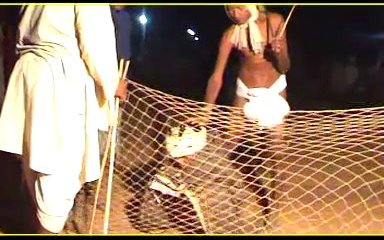
tribal game

In the night, again they perform one act where Gayta tribe becomes prey, Nayak tribe become hunter and Yemla tribe become sirha. Here, they trap their prey by nets.
Faagun Shukla Trayodashi- CHITALMAAR
The day starts with the pooja of Maa Kaalratri. In the night, In an act, Gayta tribe becomes prey(Chital means deer) and Yemla and nayak tribe become hunter.
Faagun Shukla Chaturdashi- GAURMAAR
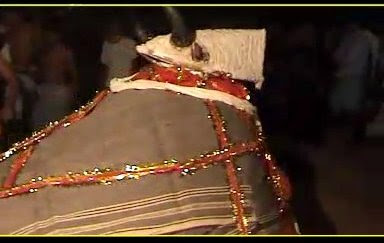
The day starts with the pooja of Mata Gauri. This day, Royal family comes for worshipping. In the night, in an act, Samrath tribal man become prey(Gaur means wild buffalo) and Goddess danteshwari priest family man become hunter.
Samrath tribe

Faagun Shukla Poornima- AWARAMAAR
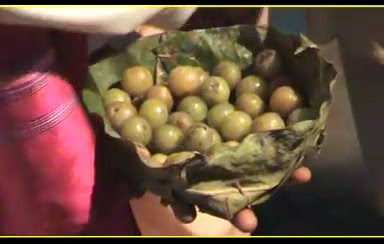
This is the day of Awaramaar custom and Holika-dahan. The day begins with the pooja of Maa Siddhidatri. Then sobha-yatra of all deities is performed. At the time of retreat of deities, all the tribes and villagers play hitting each other by Awla. Hence it is names as Awaramaar.
Aawla
Then the branch of palm tree is taken to Log of woods of Holi and kept along with the wood logs and they are worshipped by the priest and Bara-lankawaar and then they perform ‘Holika Dahan” and greet each-other and sing Faag songs.
Faagun Shukla Pratipadaa- PADUKA-PUJAN & RANG-BHANG
In this last day, all followers, visitors and tribes play holi with each other, inviting Goddess Danteshwari and all other deities. In the last, they bath at the bank of confluence of river Shankini and Dankini. Then the pooja of Bhairam baba is performed.
tribe pooja
source: www.dantewada.gov.in
Finally, the last day comes for the retreat of all deities. It’s a emotional farewell.
Conclusion: Here you saw, how these tribes are attached to their traditions and values. One contrasting feature more, what I noticed is that, these tribes have great affection for nature and its creatures, yet they depend on hunt for their livelihood, hence they offer their prayer to Goddess by giving a good hunt in order to make their clan pleased with the blessings of Goddess.

Mandawa Waterfall

Mandawa Waterfall, Jagdalpur, Bastar

Adding an adjective to praise the beauty of Bastar, I will call it “Virgin Bastar”. It’s so ‘coz the more we try to unveil, the more it seems to have hidden in her laps. Now to the collection of her jewels, we are adding one more gem i.e. Mandawa Waterfall. Next to Chitradhara, this waterfall is one of the nearest waterfalls of Jagdalpur. It’s so beautiful, so fresh, so unseen site, that if properly promoted, it can be one of the most promising tourist paradises of Bastar.
Jagdalpur Waterfall
Fig: Mandawa @ Downstairs Photograph by: Jeet Singh Arya
Where and How to Reach?
Mandawa waterfall is located in a place called Mandawa at village Dodrepal which is 5kms from Mavlibhata, a village on the left side of NH-16 (Jagdalpur-Geedam road), which is around 31kms away from Jagdalpur. One alternate way is…just 7kms from Raikote, but here you have to park/leave your vehicle 3kms before this waterfall. One more approach road goes from Tokapal (20kms from Jagdalpur). Due to its short distance, u can visit this place, and return back within few hours.
bastar map
courtsey: www.mapsofindia.com

For lodging and boarding, there are many good resorts and hotels in Jagdalpur. Some of the hotels provide exciting tour packages also. For the ease of tourist and visitors, Govt. has made some good rest house and guest houses in Divisional Head quarter, Jagdalpur. Obviously for a waterfall, October to February is the best time to visit.
bastar tourism
Photograph by: Ashish Gadpale

Being in Mandawa Waterfall:
Mandawa is just like a mystic beauty, a combination of a small short remote untrodden valley, a series of cascades, greenery on the both sides of valley…….isn’t it a big thing in a small package!! Just before this waterfall, there is a mountainous stream which has been bound by a nala bund, which has its origin 20kms away to the southwest from the mountains near Katenaar, Gumadpal, Pakhnaar, this stream(nala) is called Mungabahar nala, as there is one village called Munga, near the origin of this stream. In local language, a stream is also called as “Bahar”, hence this stream got its name as “Mungabahar”. Even being a short stream, this nala never gets dry.

small waterfall
Photograph by: Jeet Singh Arya

picnic spotRight Lateral view of Mandawa Photograph by: Jitendra Nakka


In this Mungabahar nala itself, at Mandawa, the stream water flows step-wise and falls from a height of 70 ft to make a beautiful cascade called Mandawa Waterfall. The water from this waterfall collects there in a small reservoir(jalkund), but again disappears after some distance, as it meets Kanger river as its tributary and form two another waterfalls i.e. Tirathgarh and Kanger-dhara. The rocks on either sides of valley of this waterfall are as thick as up to 200ft wide, in some areas it is wide up to 300ft also. Due to its flat top and adjacent horizontal rocks, it is very easy to enjoy up to any extent of this waterfall, hence it is gradually getting fame, and now people have started opting this site as their picnic spot.
lake rocksPhotograph by: Ashish Gadpale


picnic waterfall
Photograph by: Jeet Singh Arya

On the flat top of this waterfall, there are some rock statues of Shivling and Nandi. Recently a small temple has also been made there in order to protect this idols and statues. Nearby there is one tree where there are a big oval shaped rock, people used to worship it as Shiv-ling, so you can also observe a half dozen of Nandi idols near this so called Shivling. Yes, of course, people and their faith, even I too bowed down my head here. There is a local belief that if any newly married couple or any childless couple comes here and pickup this shivling shaped rock, then they will be bestowed by a baby. Hence, this belief makes this place more worthy, spiritual and divine also. Yet another reason to visit this place isn’t it?


chhattisgarh tourism
Photograph by: Jeet Singh Arya
Conclusion:
Gradually, people are becoming aware of this site also, youngsters and youth are opting this waterfall as their favorite picnic site…but as this is one of the upcoming tourist site of Bastar, the approach road is yet to be prepared and metalled. Govt. should proceed in order to promote this beautiful mystic waterfall.

Note: This blog is devoted for my frns- “Jeet Singh Arya” and "Ashish Gadpale" who helped me in getting data about this place and took so beautiful pictures of this site. Cheers to you guys.

Charre-marre Waterfall

Charre-marre Waterfall
Dense forest, sharp curving valleys, enchanting mountains, the innumerous cascades and rapids, this is what Chhattisgarh is all about. Nature has embraced Chhattisgarh to its extreme. But wait……..you must know why? Nature will convince to adore any place, only when you leave the place untrodden. But it’s a human nature…he always likes to explore new aim, new goal, new places……one such perfect tourist destination is the Charre-marre waterfall of Kanker .
Charre-marre Waterfall
source: www.kanker.gov.in
Where and How to reach?
Charre-marre waterfall is known as the jewel or crown of Kanker district. On National highway no. 30 i.e. between Jagdalpur to Raipur; from Kanker via Bhanupratappur and Antagarh, a metalled road(state highway) goes upto Narayanpur. In this way at Antagarh, just 12 km away from it, lies the beautiful waterfall of Charre-marre. One more alternate is there, you can reach Kondagaon (comes between NH-30, 70 kms from Jagdalpur) and follow the state highway to Antagarh via Narayanpur. Regarding lodging and boarding, rest houses are available in Narayanpur and Antagarh and as Narayanpur is the District Head Quarter, you can easily get necessary materials required for your tour.
Kanker tourism
source: www.mapsofindia.com

Obviously rainy season is the best season to enjoy any waterfall, whereas October to December is more advisable, as it is a mountainous river and tends to be wild during rains.
Salient Features:
12 kms from Antagarh, towards Amabeda, lies the beautiful valley of “Pinjadin” , the beauty of which is doubled by the leaf shading forest, sharp U and V blind turns of the approach road. This valley has got a beautiful crescent shape which is venerated by giant masses of Granite rock and adored by a river called Antagarh river. Local people name it as “ Kutri nadi”. Due to this slopy turns and depression between the valley, Local people used to call this valley as “Kadaahi Khodra (means the depth of a bowl)”.
Following the stages of underlain rocks, Antagarh river falls from great height and forms Charre- marre waterfall, in addition to which 35m of fall can be seen falling straight to the reservoir(kund) below. Further moving far, it meets Kotri river, which is considered to be the tributary of Indravati and Mahanadi. Its origin is believed to be from a Nala of the Pinjadi fields near around.
One of the unique feature of this marvel is that this is the only waterfall in Bastar division, which can be enjoyed as one complete view, otherwise in other waterfalls like Tirathgarh, Chitrakote e.t.c, you have to come down to the fall depth to enjoy in its extreme. So, Charre-marre is not provided by any watch tower or gallery, in fact, it is beautiful from any view.
On one side of its upper view, there lie two idols of Lord Hanuman…one of which is ruined and kept exposed outside, while the other one is still in better condition, and kept inside a house shaped temple, built by the local bodies. Mostly people used to offer nearby stones or pebbles to Lord Hanuman’s Idols, as the local people believe that clapping and then offering stones (during prayers) will render them blessing when the stone will be accepted. Due to this fact only, people offer stone donation to Lord Hanuman there.
Conclusion:
The fall is so famous in Kanker and the neighbouring districts that tourist start flooding right from the beginning of rains, but as the valley is very slopy, site seeing in winter is most advisable. Inviting forest, beautiful mountainous river, enchanting valley, exotic cascade……what else you want for the best of your tour!!!! In the end, I must suggest that this is an ideal site for tracking.
(Note: A part of this citation is inspired from the facts given by Dr. Suresh Tiwari. I pay my heartfelt thanks to Dr. Suresh Tiwari for inspiring me by writing such a great book- “Bastar-Paryatan, Itihaas aur Sanskriti”.)